 MicoRadar
Périgord black truffle
Tuber melanosporum
Also called: Black truffle, Périgord truffle
In Spanish: Trufa negra, Trufa de Périgord, Trufa violeta · In Catalan: Tòfona negra, Tòfona de Perigord, Tòfona d'hivern · In Basque: Boilur beltz, Boilur · In Galician: Trufa negra, Trufa de Périgord
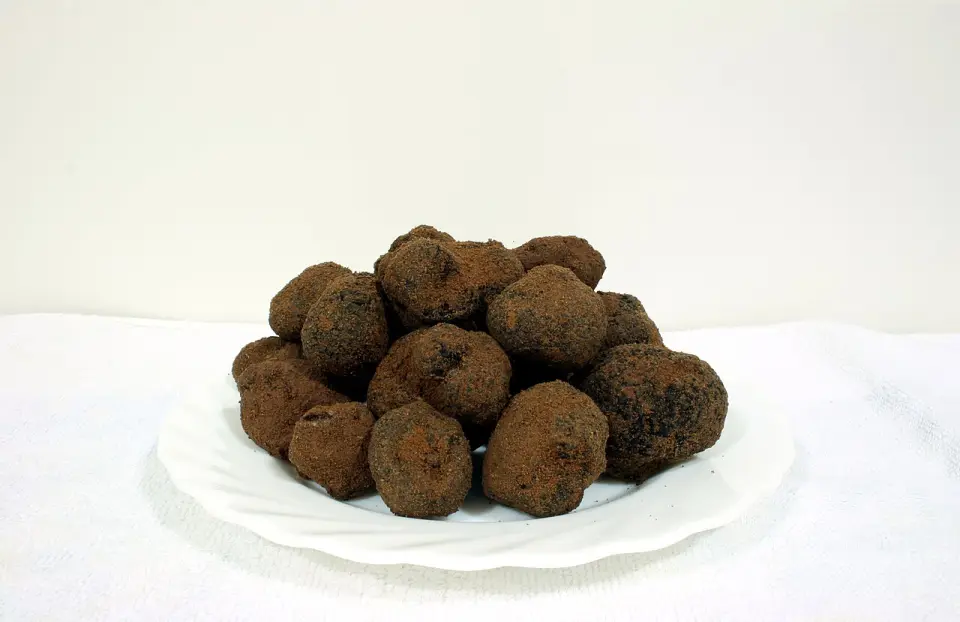
Photo: Diego Delso / Wikimedia Commons · CC BY-SA 3.0
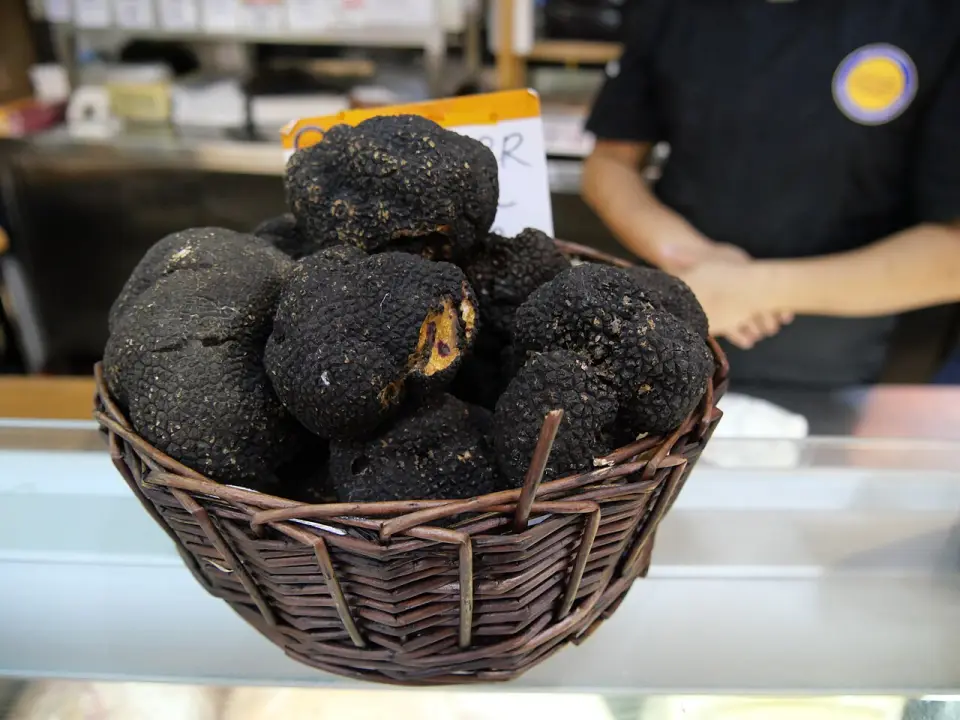
Photo: Peachyeung316 / Wikimedia Commons · CC BY-SA 4.0
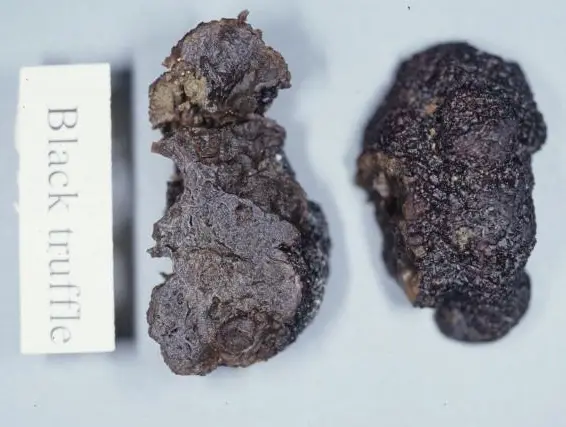
Photo: landcare research / Wikimedia Commons · CC BY 3.0
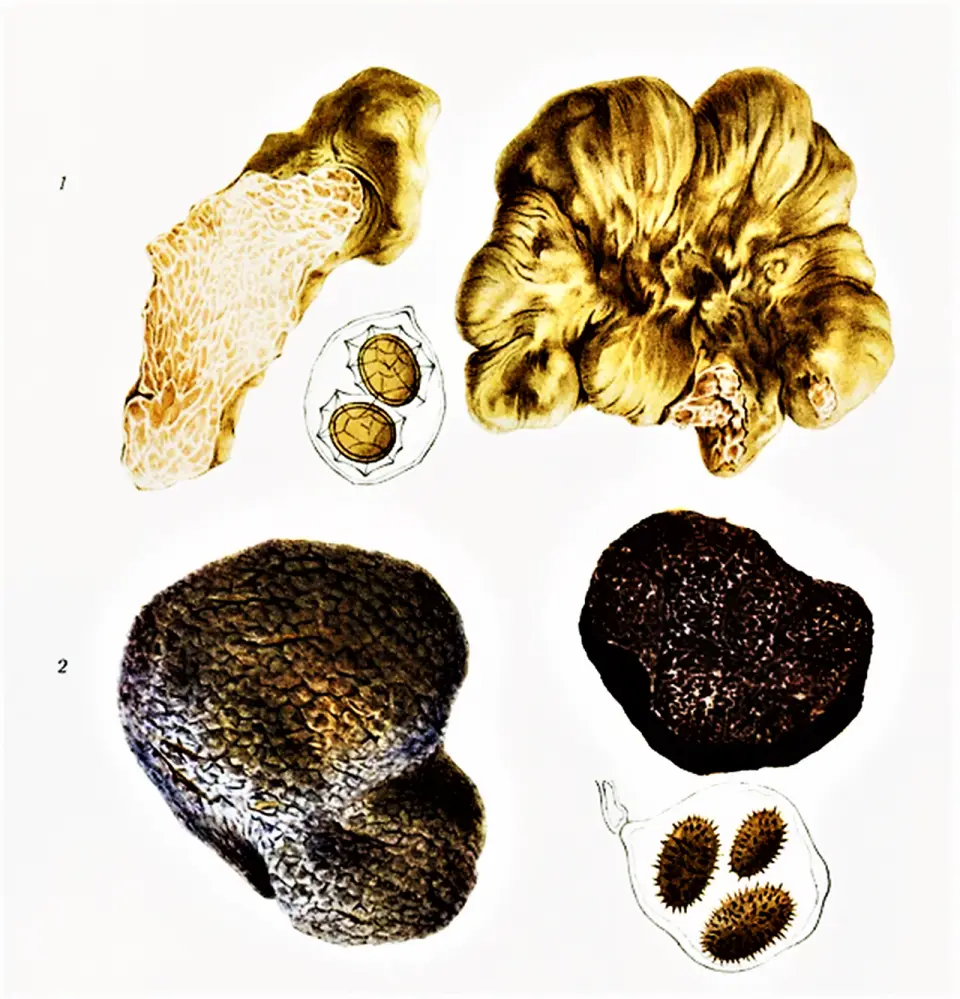
Photo: Giacomo Bresadola / Wikimedia Commons · Public domain
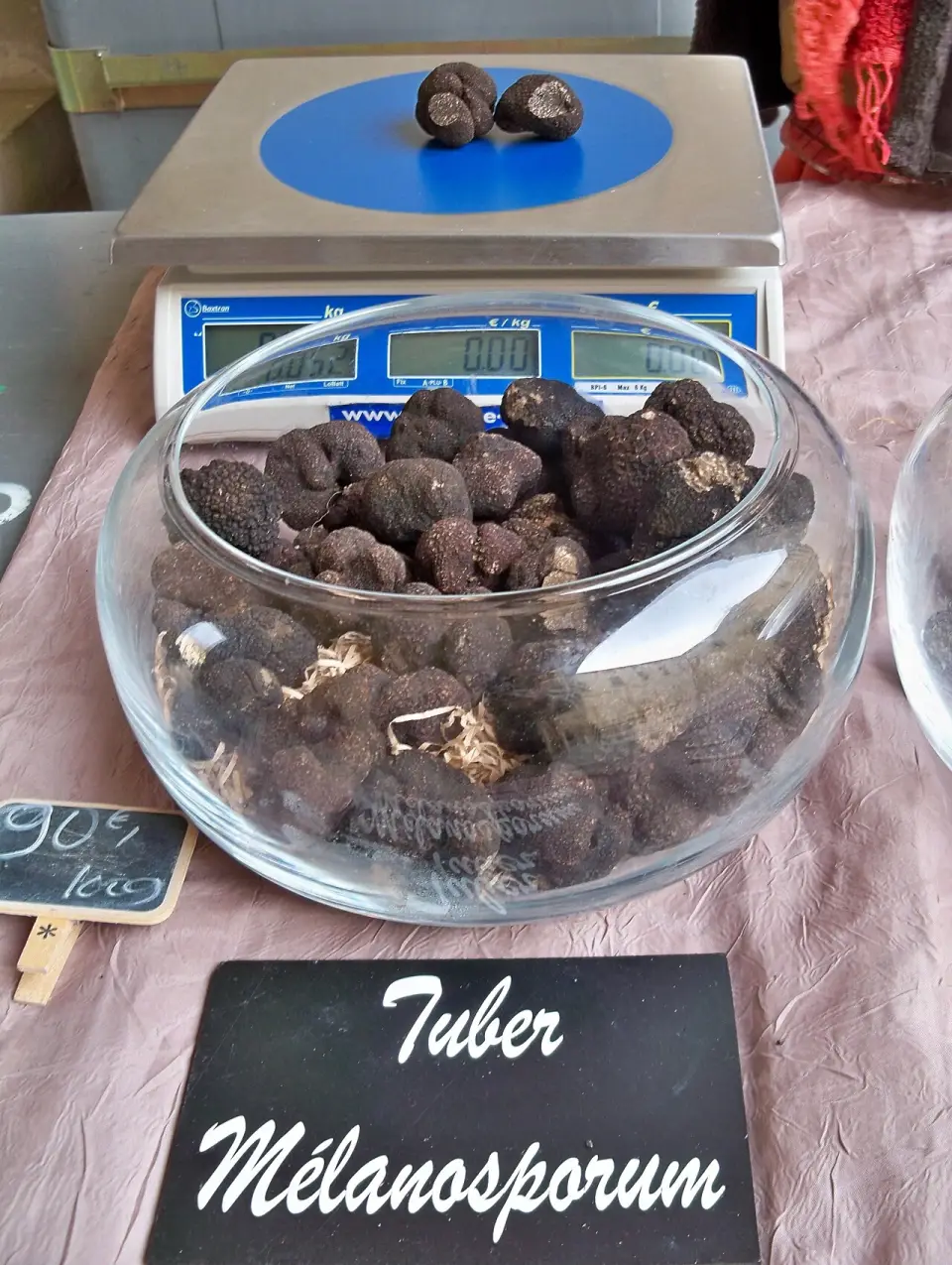
Photo: Marianne Casamance / Wikimedia Commons · CC BY-SA 3.0
Photo: Dale Cruse from San Francisco, CA, USA / Wikimedia Commons · CC BY 2.0
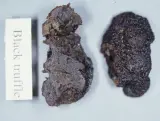
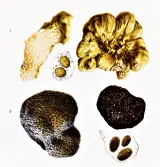
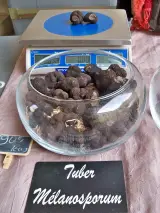
Not a cap-and-stem mushroom but an underground fruiting body, 2–7 cm and irregular, its black rind covered in small pyramidal warts. Cut open, the flesh is blackish-purple and threaded with fine, dense white veins that redden on contact with air. The aroma is intense and leaves no doubt; it is what the price is for.
Quick facts
- Scientific name
- Tuber melanosporum Vittad. (1831)
- Family
- Tuberaceae
- Edibility
- Edible
- Season
- Nov–Mar
- Usual altitude
- 565–1,137 m
- Under which trees
- Holm oak, Oak, Hazel
- IUCN Red List
- Not evaluated (NE)
Where it grows
Mycorrhizal with holm oak and Portuguese oak on dry, well-drained limestone, on sunny mid-mountain slopes. Spain's truffle heartland is Teruel — Sarrión and the Sierra de Gúdar — followed by Soria, Castellón and the Maestrazgo. It is gathered December to March, and always with a trained dog: nothing on the surface gives it away. The overwhelming majority of Spanish production comes from private plantations, and walking into one uninvited is a crime rather than an oversight.
Confused with
- Winter truffleTuber brumale
It grows in the same soils under the same trees. Its flesh is greyer and its white veins coarser and further apart, and the aroma is weaker with a musky undertone. Edible but far less valuable, and it frequently turns up mixed into lots sold as melanosporum.
- Chinese truffleTuber indicum
All but identical from the outside and nearly scentless. It does not grow in Spain: it arrives imported, and it is the standard fraud of the truffle trade. The difference is in the smell, not the look.
When it has been found
Finds recorded in Spain, by month: 102 in all, from GBIF. They show when it fruits, and also when people go looking.
Where it has been found
Each square is an area of about 20 km with recorded finds; the darker, the more finds. It does not pinpoint patches: for where it is coming up now, see the forecast map.
Where it comes up
Areas where this species is scoring highest right now.
- Montseny massif MassifsWeak · peak moderate
- Garrotxa ComarcasWeak · peak moderate
- Osona ComarcasWeak · peak moderate
- Moianès ComarcasVery weak · peak moderate
- Berguedà ComarcasVery weak · peak moderate
- Vallés Oriental ComarcasVery weak · peak moderate
- Ripollés ComarcasVery weak · peak moderate
- Lluçanès ComarcasVery weak · peak weak
In guides and news
Sources
The usual altitude and the trees come from our own fit of the model to those finds and to the Spanish Forest Map (Mapa Forestal de España).
Would you know them from a photograph? →
The description is for reference. Identifying a mushroom from a photograph is unreliable: do not eat anything you are not sure of.