 MicoRadar
Poisonous mushrooms of Spain
The 10 dangerous species in the catalogue, ordered by what they actually do: first the ones that kill, then the ones that end in A&E. For each: the toxin, how long before it shows, and what it is confused with.
If somebody has eaten a mushroom and feels ill
- Go to hospital even if the symptoms seem mild, and even if they have already passed. With amatoxins, feeling better is part of the course.
- Keep whatever is left: raw remains, leftovers on the plate, the bin, even the vomit. Identifying the species changes the treatment.
- Write down the time of the meal and the time of the first symptom. That interval is the single most useful thing a doctor can be told.
- Anyone who shared the meal should be seen too, even if they are fine: symptoms do not reach everybody at once.
- Do not induce vomiting, and do not give milk, alcohol or home remedies.
The clock rule
The later it starts, the worse it usually is. Under two hours it is nearly always a stomach upset that passes; from six hours on, think amatoxins, and there time is the treatment. The exception is worth knowing: Inocybe erubescens shows within minutes and can kill all the same. So the rule is there to alarm you, never to reassure you.
The ones that kill
One meal is enough. None of these has an antidote that gives back what has been destroyed: what decides the outcome is reaching hospital early.
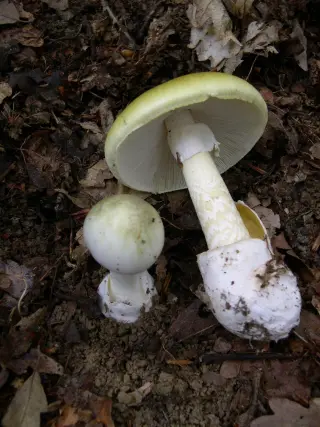
Death cap
DeadlyAmanita phalloides
- Toxin
- Amatoxins
- First symptoms
- 6 to 24 hours
Violent vomiting and diarrhoea that ease off the next day. That apparent recovery is part of the course: while it lasts, the liver goes on being destroyed. A single fruit body holds a lethal dose for an adult, and this species is held responsible for the great majority of mushroom deaths in Europe.
Open the full card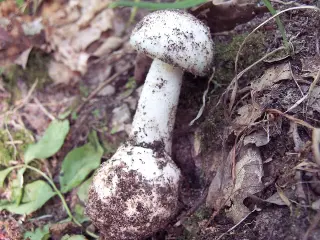
Fool's mushroom
DeadlyAmanita verna
- Toxin
- Amatoxins
- First symptoms
- 6 to 24 hours
The same poison and the same course as the death cap, but in spring, when nobody has their guard up. White throughout: it is taken for a field mushroom, and it comes up in the same months as the St George's mushroom.
Open the full card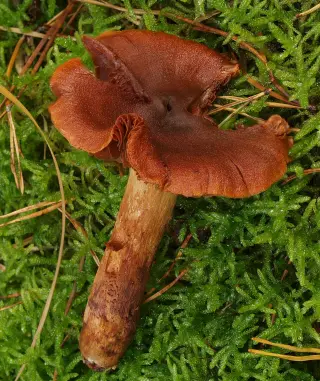
Fool's webcap
DeadlyCortinarius orellanus
- Toxin
- Orellanine
- First symptoms
- A few days to three weeks
The hardest case of all, because days pass with nothing. By the time the raging thirst, the lack of urine and the back pain arrive, the kidney is damaged and often past saving. Whoever ate it does not connect the two, so the date of that meal is the thing to tell the hospital.
Open the full card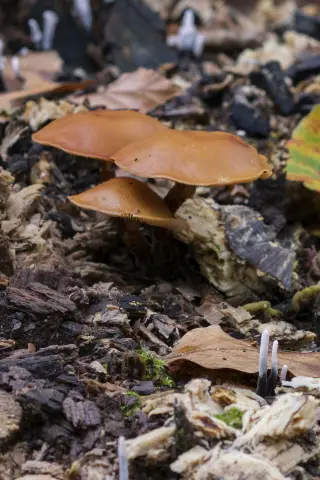
Funeral bell
DeadlyGalerina marginata
- Toxin
- Amatoxins
- First symptoms
- 6 to 24 hours
The same amatoxins as the death cap, in a small brown mushroom growing on wood beside the ones people do pick off stumps. There is no visual shortcut that separates it: small, brown and out of wood does not go in the basket.
Open the full card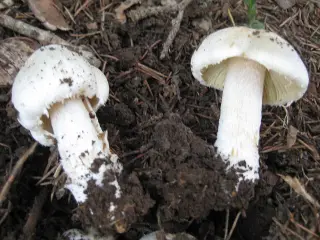
Deadly fibrecap
DeadlyInocybe erubescens
- Toxin
- Muscarine
- First symptoms
- 15 minutes to 2 hours
The exception to the clock rule: it starts early and can still kill. Heavy sweating, salivation, watering eyes, small pupils and a slow pulse. There is an antidote — atropine — which is why arriving early changes the outcome.
Open the full card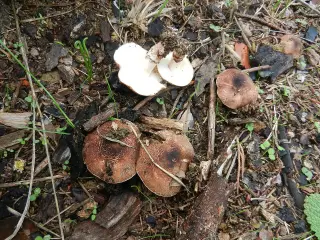
Deadly dapperling
DeadlyLepiota brunneoincarnata
- Toxin
- Amatoxins
- First symptoms
- 6 to 24 hours
Two or three five-centimetre caps carry a lethal dose for an adult. It comes up on lawns, in parks and along verges — where nobody expects anything dangerous — and it kills in Spain almost every autumn, often whole families who took it for a small parasol.
Open the full cardThe ones that end in A&E
They do not usually kill a healthy adult, and they are still admissions, drips and a very bad day. In a child or an older person, any of them is a serious emergency.
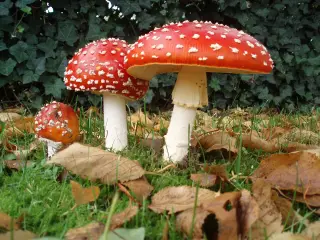
Fly agaric
ToxicAmanita muscaria
- Toxin
- Ibotenic acid and muscimol
- First symptoms
- 30 minutes to 3 hours
Confusion, drowsiness, agitation and sometimes hallucinations; in children, seizures. It rarely kills an adult, but it is an admission, and in a child it is a serious emergency.
Open the full card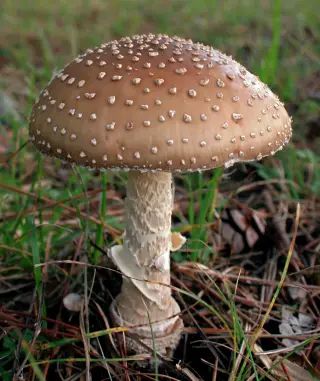
Panther cap
ToxicAmanita pantherina
- Toxin
- Ibotenic acid and muscimol
- First symptoms
- 30 minutes to 3 hours
The same picture as the fly agaric and considerably stronger, with severe poisonings every season. Not being red, it puts nobody on guard: it is confused with Amanita rubescens, which is edible once cooked.
Open the full card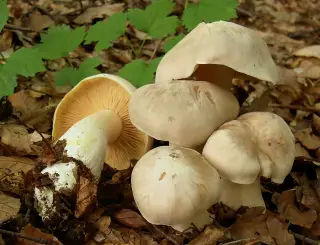
Livid entoloma
ToxicEntoloma sinuatum
- Toxin
- An unidentified gut toxin
- First symptoms
- 30 minutes to 2 hours
Heavy, prolonged vomiting and diarrhoea, with dehydration that may need a drip. It is one of the commonest mushroom poisonings in Europe, and the reason is the smell: it smells of flour like the St George's mushroom and like the miller, and smell is not enough to separate them.
Open the full card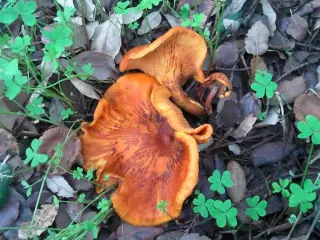
Jack-o'-lantern
ToxicOmphalotus olearius
- Toxin
- Illudins
- First symptoms
- 30 minutes to 3 hours
Hours of violent vomiting and cramps. It is confused with the chanterelle and with the king oyster; what gives it away is that the orange runs through the flesh and not only over the surface, and that it has true gills where a chanterelle has blunt folds.
Open the full cardWould you know them from a photograph?
The quiz uses these same species and the ones that resemble them.
Common questions
How can you tell whether a mushroom is poisonous?
There is no general rule that works. Not colour, not whether slugs have eaten it, not whether it blackens a silver spoon, not whether it smells good: every one of those tricks has fatal counter-examples, and the death cap passes nearly all of them. The only way is to identify the species by its characters — cap, gills or pores, stem, ring, volva, spore print and what it grows on — and to leave out of the basket anything not recognised with certainty.
How long do symptoms take to appear?
Between fifteen minutes and three weeks, depending on the toxin. Under two hours is usually a stomach upset that passes; six to twenty-four hours is the amatoxin window, and those are the ones that kill; and the orellanine in the fool's webcap can take up to three weeks. There is one important exception: Inocybe erubescens starts within minutes and can be fatal.
Which is the most dangerous mushroom in Spain?
Amanita phalloides, the death cap. One fruit body is a lethal dose for an adult, it gives no warning for six hours or more, and it grows in holm oak and oak woods across almost the whole peninsula. Lepiota brunneoincarnata challenges it by another route: it is small, it comes up on town lawns, and it causes fatal poisonings in Spain almost every autumn.
Does cooking destroy the poison?
Not in the species on this page. Amatoxins and orellanine survive cooking, drying and freezing intact. Some species do need cooking before they can be eaten — Amanita rubescens, or Neoboletus erythropus — but that is a different matter, and it is not a treatment that turns a toxic mushroom into an edible one.
I ate a wild mushroom and I feel fine. Should I worry?
If you know for certain which species it was, no. If you do not, feeling fine two hours later rules nothing out: the worst cases take six to twenty-four hours to begin. Keep whatever is left uneaten, note the time, and ring the poison information service (+34 91 562 04 20) to be told whether anything needs doing.
Sources: The characters of each species and the confusions come from our own cards, checked against Wikipedia, Fungipedia, First Nature and the Aranzadi Society of Sciences. The telephone number is that of the poison information service of Spain's National Institute of Toxicology and Forensic Science.
This page is for recognising a mushroom and for knowing who to ring. It is not a diagnosis and does not replace medical care: where poisoning is suspected, go to hospital.