 MicoRadar
GuidesArea guides
Urbión pinewoods: permit, altitudes and season
A guide to the pine forests of Urbión in northern Soria: tree species and altitude belts, the model's estimated season windows, the separate coto licence and the rules of Castilla y León.
updated October 2, 2026
On this page
The Urbión pinewoods in the north of the province of Soria are an almost unbroken Scots pine forest in the valleys of the Revinuesa and the Duero, around Covaleda, Duruelo de la Sierra and Vinuesa; the highest parts are occupied by the Laguna Negra y Circos Glaciares de Urbión natural park. The forest here is simple and uniform, but the boundaries are not: different collecting regimes operate side by side, and a licence for one zone is not valid in the next. The easiest way to spoil a trip is to buy a permit for the wrong zone or to put a prohibited tool in your rucksack. So below you will find what to arrange in advance, what altitudes to expect, which months are worth considering and which rules apply on top of the permit.
From here on, by “calculation” and “model” I mean MicoRadar's estimates: it calculates conditions and parameters by species and does not record finds.
Pinewoods in the valleys, no forest above 1,800 m
The forest here is uniform, which makes planning easier: according to the model's calculated profile, almost all of the forest area is Scots pine, with the other species far behind.
| Species | Share | Area |
|---|---|---|
| Pinus sylvestris | 67.6% | 295.8 km² |
| Quercus pyrenaica | 17.6% | 76.8 km² |
| Fagus sylvatica | 6.8% | 29.6 km² |
| Juniperus communis | 2.0% | — |
| Ilex aquifolium | 1.7% | — |
Total forest area is 437.6 km². Cell altitudes: minimum 1,042 m, median 1,501 m, maximum 2,087 m 1.
The park's page explains how this is distributed across the slopes: pine almost completely covers the valleys of the Revinuesa and the Duero, and above 1,400 m beech appears on shaded, steeply sloping ground, sometimes in small separate stands and sometimes mixed with pine. Above 1,800 m, long-lying snow and cold winds leave only scrub and grassland, and there is no forest 4.
Now compare this with the calculation by species. The highest optimum belongs to the Slippery jack, reaching 1,718 m, and for the other species of interest the upper limit is lower still 2. So the whole upper part of the territory, both the treeless zone and the belt below it, lies above the calculated optimum. Climbing to the highest points makes sense as a walk, not as part of a mushrooming plan.
When to go: autumn under pine, summer under oak
This is the main conclusion from the table below: oak woods give an earlier summer season, while pinewoods give autumn and early winter. The windows themselves are the periods the model uses for the whole of Spain, not a calendar specific to Urbión.
| Species | Forest | Model window | Altitude optimum |
|---|---|---|---|
| Penny bun, porcini (Boletus edulis) | Pinus sylvestris | September–November | 298–1,645 m |
| Pine bolete (Boletus pinophilus) | Pinus sylvestris | September–November | 544–1,659 m |
| Saffron milk cap (Lactarius deliciosus) | Pinus sylvestris | September–December | 255–1,497 m |
| Slippery jack (Suillus luteus) | Pinus sylvestris | September–December | 606–1,718 m |
| Chanterelle (Cantharellus cibarius) | Pinus sylvestris | June–December | 145–1,428 m |
| Tricholoma portentosum | Pinus sylvestris | October–December | 371–1,699 m |
| Summer cep (Boletus reticulatus) | Quercus pyrenaica | June–November | 297–1,353 m |
| Boletus aereus | Quercus pyrenaica | August–November | 241–1,109 m |
| Russula cyanoxantha | Quercus pyrenaica | June–November | 311–1,226 m |
There is also a species that is not in the model's list at all: Hygrophorus marzuolus. The coto website says it breaks the general rule: it appears from February to April, sometimes as early as January, and stays on shaded slopes of Scots pine woods, mainly on siliceous soils 13. So a February trip here is not pointless; you just will not have a calculation for this species.
In the same forests the model also calculates deadly poisonous species: Amanita phalloides, the Death cap, under oak and beech from September to December, Cortinarius orellanus in the same places from September to November, and Galerina marginata under pine and beech from September to December 2. I do not give identification features here, and neither does the poisonous mushrooms section, which is about which species the model expects nearby.
You need a permit, and a local one
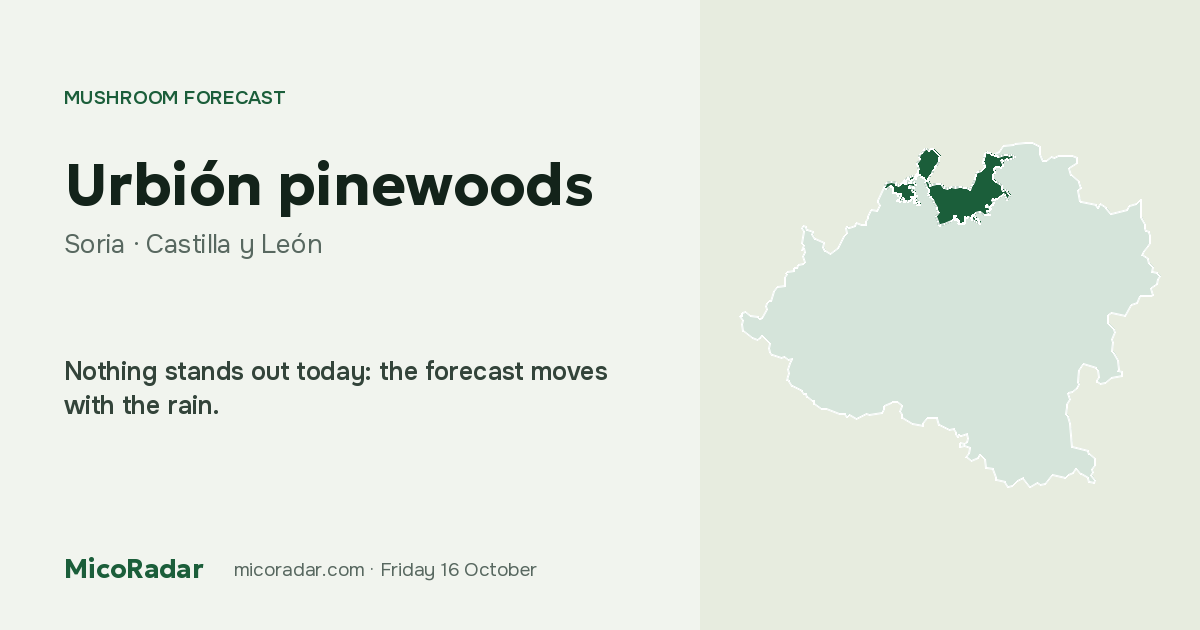
The Urbión pinewoods are a separate regulated zone (acotado) with the code SO-50001. Its owners are six municipalities, Covaleda, Duruelo de la Sierra, Vinuesa, Molinos de Duero, Montenegro de Cameros and Salduero, its area is more than 24,000 ha, and the licence is sold on the coto's own website 57.
Around it lies a different territory: the Montes de Soria mushroom park (PMSO-50001), 127,909.88 ha across 64 municipalities in Soria and two in Burgos, with its own permit and its own rates 89. These are two independent systems. Do not assume that a licence for one zone gives you anything in the other; first find out whose land you are going to walk on.
Prices differ between the two sources
The result is that the same permit for a visitor costs different amounts depending on where you look.
I will not try to explain the discrepancy. The price you see when buying on the zone's website is the one that applies. The limit according to the coto website is up to 5 kg for both the two-day and the seven-day licence; for people registered as residents in these municipalities, both are free 6. In the Montes de Soria park, the general recreational permit for two days costs €10 and allows you to collect up to 5 kg over two consecutive days 9.
The rules of Castilla y León apply on top of the permit
They are the same across the whole autonomous community, under Decreto 31/2017. The most important point for planning: in an acotado, all collecting is regulated, and occasional collecting is excluded, except for species not covered by the regulation. The famous 3 kg a day “without a permit” applies to land outside an acotado and only for personal use, with no selling and no truffles 10.
Next come the things visitors trip over. You may not carry or use sickles, rakes, hoes and similar tools; of cutting tools, only a knife, a folding knife or scissors with a blade shorter than 11 cm are allowed. Collecting at night, from sunset to sunrise, is prohibited. The container must be rigid or semi-rigid and porous on all sides. You may not collect within the strips alongside state, regional and provincial roads or within the railway right-of-way. You must carry an identity document and the permit for the regulated zone 11.
You will see the boundary on a sign: white background, black lettering “Acotado de setas. Prohibido recolectar sin permiso de recolección”, and in a mushroom park “Parque micológico. Prohibido recolectar sin permiso de recolección” 12.
How the MicoRadar map can help
It has two layers that neither the coto nor the register has. The first is the daily calculation by species: for the forest composition and the current forecast, see the area page, so there is no point duplicating them in the guide. The second is a layer of the regulated zones of Castilla y León, compiled from the official register: it shows where someone else's licence begins, and it is handy to check on the map before you set out. The layer may lag behind changes, so the final word belongs to the sign on site and the website of the zone itself.
Before you go
- Work out whose zone you are going to, the Pinares de Urbión coto or the Montes de Soria park, and buy the permit on that zone's website.
- Check the price and the duration at the moment of purchase: the two official sources disagree.
- Keep your document and a printout or screenshot of the permit where you can reach them without unpacking your rucksack.
- Pack your container: a rigid, porous basket, a knife with a blade shorter than 11 cm, no rakes or sickles.
- Plan your route along the forest belt, not over the summits: there is no forest above 1,800 m, and the calculated optimum ends lower still.
- Look at the calculation by species on the map and the weekend forecast a day or two before the trip.
If you feel unwell after eating wild mushrooms, call 112.
Prices, limits and names are given as in the sources on 01.10.2026; they change, so check on the zone's website before buying.
How your area looks today
Every morning the map works out, species by species, where the weather and the forest favour mushrooms.
Open the mapSources
- 1.MicoRadar (datos del modelo). Pinares de Urbión: bosque y altitud (perfil calculado el 10.09.2026). https://micoradar.com/es/zonas/pinares-de-urbion
- 2.MicoRadar (datos del modelo). Especies que el modelo calcula en estos bosques: ventana de temporada y altitud (consultado el 01.10.2026). https://micoradar.com/es/zonas/pinares-de-urbion
- 3.Fundación Patrimonio Natural de Castilla y León. Parque natural Laguna Negra y Circos Glaciares de Urbión: extensión y situación. https://patrimonionatural.org/espacios-naturales/parque-natural/parque-natural-laguna-negra-y-circos-glaciares-de-urbion
- 4.Fundación Patrimonio Natural de Castilla y León. Parque natural Laguna Negra y Circos Glaciares de Urbión: vegetación por altitud. https://patrimonionatural.org/espacios-naturales/parque-natural/parque-natural-laguna-negra-y-circos-glaciares-de-urbion
- 5.Coto Micológico Pinares de Urbión. Licencias: titulares y superficie del coto. https://www.pinaresdeurbion.es/licencias/
- 6.Coto Micológico Pinares de Urbión. Tarifas licencias (tal como figuran en la web del coto el 01.10.2026). https://www.pinaresdeurbion.es/licencias/
- 7.Micología CyL (Junta de Castilla y León / Cesefor). SO-50001 / Acotado de Covaleda - Asociación Pinares de Urbión: ficha del registro. https://micologiacyl.es/areas/so-50001
- 8.Micología CyL (Junta de Castilla y León / Cesefor). Parque Micológico "Montes de Soria" (PMSO-50001): descripción. https://micologiacyl.es/parque/pmso-50001
- 9.Micología CyL — expedición de permisos. PMSO-50001 / Parque Micológico Montes de Soria: tarifas y permiso general. https://permisos.micologiacyl.es/acotado/montes-de-soria
- 10.BOCYL núm. 194, 9 de octubre de 2017. Decreto 31/2017: aprovechamiento episódico y recolección en acotados (arts. 13 y 17). https://medioambiente.jcyl.es/web/jcyl/binarios/577/355/BOCYL-D-09102017-1.pdf
- 11.BOCYL núm. 194, 9 de octubre de 2017. Decreto 31/2017: prescripciones de recolección (art. 8). https://medioambiente.jcyl.es/web/jcyl/binarios/577/355/BOCYL-D-09102017-1.pdf
- 12.BOCYL núm. 194, 9 de octubre de 2017. Decreto 31/2017: señalización (art. 23). https://medioambiente.jcyl.es/web/jcyl/binarios/577/355/BOCYL-D-09102017-1.pdf
- 13.Coto Micológico Pinares de Urbión. Guía de setas: marzuelo (Hygrophorus marzuolus). https://www.pinaresdeurbion.es/guia-setas/marzuelo/
What our model says is a forecast, not an observation. No mushroom can be safely identified from a photo or an app; if in any doubt, do not eat it. If anyone feels unwell after eating wild mushrooms, call 112.