 MicoRadar
GuidesArea guides
Huesca Pyrenees: altitude, permits and Ordesa
A guide to mushroom picking in the Huesca Pyrenees: why you should head for the lower belt, how Aragón's rules and municipal permits work, and why visitors may not pick inside Ordesa National Park.
updated October 2, 2026
On this page
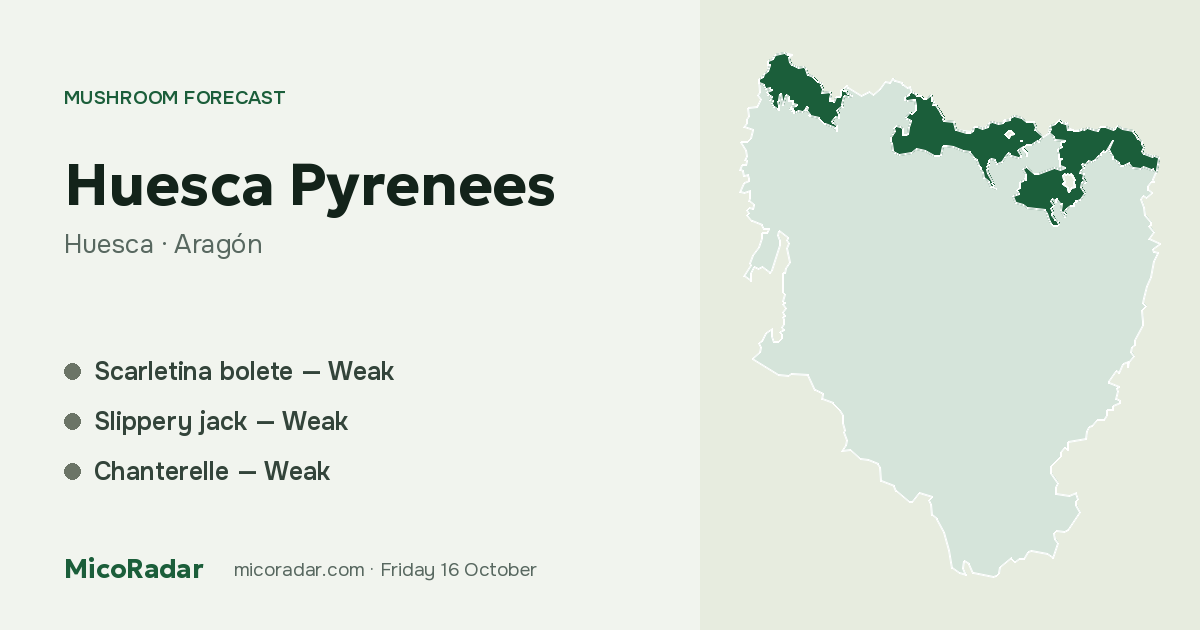
The Huesca Pyrenees are the highest territory of all those we cover in Spain. For a mushroom picker, two things follow. First: half the area lies above the ceiling where the calculation for Penny bun, porcini and Slippery jack gives anything useful at all, so you need to head for the lower belt, not just "the Pyrenees" in general. Second: the right to pick here is decided not at regional level but by a sign at the edge of the wood and by the ordinance of the individual municipality, and inside Ordesa National Park a visitor may not pick at all. That is what this guide is about.
Where to go: mushroom forest is the lower half
The short answer: valleys and slopes, not everything that looks like high mountain on the map. The zone's forest cells start at 737 m, the median is 1,910 m and the top is 3,123 m; in other words, half the territory lies above the median 1. The model's altitude optimum for Penny bun, porcini ends at 1,645 m, and for Slippery jack at 1,718 m; above that the model still gives a calculated ceiling (2,319 m for Penny bun, porcini), but that is the edge of the range, not a working belt 2.
It is therefore easiest to read the belts from the top down. The page for Ordesa y Monte Perdido National Park lists them directly: holm oak, pine woodland, beech forest and then subalpine and alpine meadows; the park itself runs from 700 m along the Bellós river to 3,348 m on the summit of Monte Perdido 4. Valles Occidentales Natural Park has the best representation in Aragón of mixed Euro-Siberian forests, above all beech and fir: from 900 m on the valley floor to 2,670 m on Bisaurín, and above the forest come subalpine and mountain pastures 3. You don't need the meadows up top; you need the belt below their limit.
The forest here is pine and beech
There is little oak and fir. The zone's forest area is 667.4 km²; the model considers the climate humid for 1,462 cells out of 1,822, and the remaining 360 are sub-humid 1.
| Species | Share of forest |
|---|---|
| Pinus sylvestris (Scots pine) | 38.7% |
| Pinus uncinata (mountain pine) | 23.9% |
| Fagus sylvatica (beech) | 15.6% |
| Quercus faginea | 4.8% |
| Quercus ilex (holm oak) | 4.7% |
| Quercus humilis | 3.6% |
| Abies alba (silver fir) | 3.2% |
| Betula alba | 1.8% |
The two pines make up more than half of the forest, and beech about a sixth. In practical terms: the pine belt gives the widest range of calculated species, the beech belt has its own, and both forests lie below the meadow limit.
And a word right away on what our calculation is. MicoRadar calculates conditions: forest type, altitude, weather and the species' seasonal window. It is a model, not a record of anyone's finds, and it does not say that anything has grown in the forest.
What the model calculates under these trees
The months in the table are the seasonal windows the model uses for the whole of Spain, not a calendar for these particular Pyrenees. Altitude is the species' optimum range in the calculation 2.
| Species | Under which trees | Months (model window) | Optimum altitude |
|---|---|---|---|
| Penny bun, porcini (Boletus edulis) | Scots pine, mountain pine, beech, fir | September–November | 298–1,645 m |
| Pine bolete (Boletus pinophilus) | Scots pine, mountain pine | September–November | 544–1,659 m |
| Summer cep (Boletus reticulatus) | beech | June–November | 297–1,353 m |
| Chanterelle (Cantharellus cibarius) | Scots pine, beech | June–December | 145–1,428 m |
| Saffron milk cap (Lactarius deliciosus) | Scots pine, mountain pine | September–December | 255–1,497 m |
| Slippery jack (Suillus luteus) | Scots pine | September–December | 606–1,718 m |
| Tricholoma portentosum | mountain pine | October–December | 371–1,699 m |
| Russula cyanoxantha | beech | June–November | 311–1,226 m |
| Craterellus cornucopioides | beech | September–January | 182–1,072 m |
In the same forests the model also calculates deadly poisonous species: the Death cap (Amanita phalloides) under beech and oaks in September–December, Cortinarius orellanus in the same places in September–November, and Galerina marginata under pine and beech in September–December 2. We do not call any species edible and we do not give identification features; there is a separate section on this.
Do you need a permit?
By default, no, but that default is easily overridden. In Aragón, occasional picking, for yourself and not for profit, is unrestricted and free of charge up to 3 kg of mushrooms or 10 litres by volume per person per day; if the two disagree, weight counts 67. The rule applies on all forest land, public and private, but stops applying in two cases: if the owner has declared a ban with a sign, or if the plot is included in a regulated-use zone 67.
The signs are to be read literally. “Zona de setas reservada. Prohibida la recolección” means a reserved zone where picking is prohibited. “Aprovechamiento micológico regulado. Prohibido recolectar sin autorización” means regulated use, so do not pick without authorisation; on boards 1.5 m high they state who owns the zone 78.
In a regulated zone the permit is issued by the zone's owner; it is named, personal and non-transferable. The conditions are set by the owner themselves, and on municipal forest by the municipality's ordinance. The usual permit is recreational, up to 12 kg per person per day 68.
What this looks like in practice can be seen in the official bulletin of Huesca. The ordinance of Piedrafita de Jaca, published on 14.08.2024: a daily recreational permit costs 10 euros a day, the limit is 12 kg or 40 litres per person per day, and there are no commercial permits; children under 14 are exempt from the permit but must go with an adult who holds one 10. This is the tariff at the date of publication, and it changes. We did not find a single list of regulated zones for the district, so you need to phone the specific municipality.
Ordesa: inside the park, visitors may not pick
Ordesa y Monte Perdido National Park has its own regime, separate from and stricter than the general one. Under the management plan (PRUG), picking inside the park can only be permitted as local-resident picking (vecinal) in each municipality and must be included in the annual forest-use plan; it is non-commercial, for personal consumption only, with a maximum of 2 kg per person per day. In the reserve zones picking is not allowed at all, and the park authority can introduce additional bans. The permit is issued by the town hall on a form supplied by the park 5.
In practice this means that a visitor has no mushrooms to pick inside the park's boundaries: you will not have local-resident status. In the peripheral protection zone, Aragón's general legislation applies 5.
What to pick with, and what is not allowed
Decreto 179/2014 sets not only limits but also the method. It is forbidden to break up the soil or disturb the top layer of vegetation, whether by hand or with rakes, hoes, sickles, a pickaxe or a spade. You may not pick at night, from sunset to sunrise. You may not carry mushrooms in unventilated containers 9.
For cutting, only a knife, a folding knife or scissors are allowed. Young specimens are not taken, and neither are overmature, broken or spoiled ones. It is best to clean what you have picked on the spot, leaving the stems and rejected parts in the forest 9.
And one more point that catches people out in autumn in particular: where and when driven hunts (batidas) are marked, picking is forbidden 9.
What to look at on the map, and what is not there
The guide is for planning, while the live calculation is on the map. There you will find a forecast by species for every day, taking account of the cell's altitude and forest type, plus a separate weekend forecast and the general map of the whole country.
What the map does not have is a layer of regulated zones for Aragón. So the right to pick on a particular slope is decided by the sign on the spot and the municipality's ordinance, not by the map.
Before you set off
- Choose a belt below the meadow limit: valleys and slopes, not the high mountains.
- Look at the calculation by species for the day of your trip on the district page and on the map.
- Check whether the plot falls within the boundaries of Ordesa National Park: inside, only local-resident picking with the town hall's permission.
- Phone the municipality and ask about the ordinance, the permit and the price for your date.
- Take a knife or scissors and a ventilated basket, no rakes; clean your mushrooms in the forest.
- If you see a “reservada” or “regulado” sign, turn back or get authorisation.
If you feel unwell after eating wild mushrooms, call 112.
Prices, limits and wording were checked against the sources on 01.10.2026; they change.
How your area looks today
Every morning the map works out, species by species, where the weather and the forest favour mushrooms.
Open the mapSources
- 1.MicoRadar (datos del modelo). Pirineo de Huesca: bosque, altitud y clima (perfil calculado el 10.09.2026). https://micoradar.com/es/zonas/pirineo-de-huesca
- 2.MicoRadar (datos del modelo). Especies que el modelo calcula en estos bosques: ventana de temporada y altitud (consultado el 01.10.2026). https://micoradar.com/es/zonas/pirineo-de-huesca
- 3.Gobierno de Aragón. Parque Natural de los Valles Occidentales. https://www.aragon.es/-/parque-natural-de-los-valles-occidentales
- 4.Gobierno de Aragón. Parque Nacional de Ordesa y Monte Perdido. https://www.aragon.es/-/parque-nacional-de-ordesa-y-monte-perdido
- 5.Gobierno de Aragón. PRUG del Parque Nacional de Ordesa y Monte Perdido (Decreto 49/2015, actualizado 21.02.2022), apartado 9.2.2.2.c: setas. https://www.aragon.es/documents/20127/3427740/ORDESA_PRUG_202202.pdf/a57774e9-9bcc-1763-c516-572c871332df?t=1680181987809
- 6.Gobierno de Aragón. Recogida de setas y trufas: ámbito, tipos de aprovechamiento y permisos. https://www.aragon.es/planificacion-y-conservacion-de-areas-forestales/gestion/setas-y-trufas
- 7.BOA núm. 225, 17 de noviembre de 2014. Decreto 179/2014: titularidad, cupo episódico y zonas reservadas (arts. 3, 7 y 8). http://www.boa.aragon.es/cgi-bin/EBOA/BRSCGI?CMD=VEROBJ&MLKOB=821237503131
- 8.BOA núm. 225, 17 de noviembre de 2014. Decreto 179/2014: señalización y permisos de la zona regulada (arts. 11 y 14). http://www.boa.aragon.es/cgi-bin/EBOA/BRSCGI?CMD=VEROBJ&MLKOB=821237503131
- 9.BOA núm. 225, 17 de noviembre de 2014. Decreto 179/2014: caza y prácticas de recolección (arts. 22, 24 y 25). http://www.boa.aragon.es/cgi-bin/EBOA/BRSCGI?CMD=VEROBJ&MLKOB=821237503131
- 10.Boletín Oficial de la Provincia de Huesca núm. 157, 14 de agosto de 2024. Entidad Local Menor de Piedrafita de Jaca: Ordenanza fiscal del aprovechamiento micológico. https://www.boa.aragon.es/cgi-bin/EBOA/BRSCGI?CMD=VEROBJ&MLKOB=1347370202222&type=pdf
What our model says is a forecast, not an observation. No mushroom can be safely identified from a photo or an app; if in any doubt, do not eat it. If anyone feels unwell after eating wild mushrooms, call 112.